GREENGRADS: Coming to the Surface Design Show 2025 for the first time – but who are they?
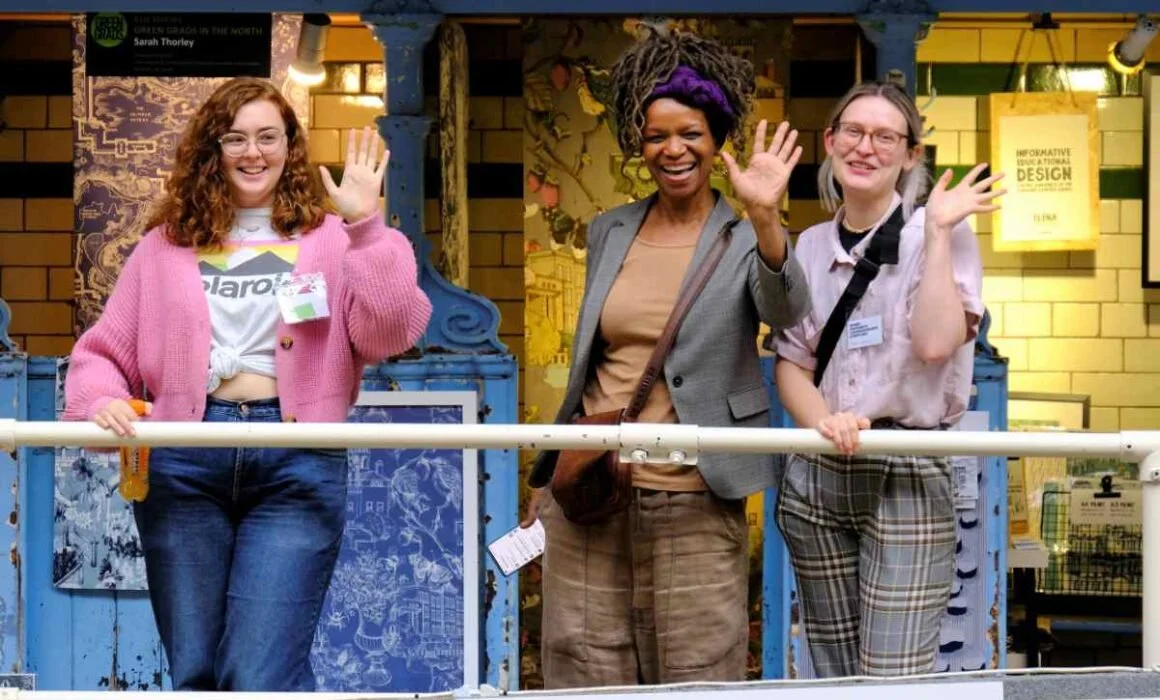
“Each of our Green Grads – and we now have 200 listed on our website – has their unique suggested way of dealing with the environmental challenges the world faces today. “Research by the British Retail Consortium shows that consumers/clients now put sustainability right at the top of their buying criteria.” Barbara Chandler
GREEN GRADS is kindly sponsored in*part by Texintel Global Partners, FESPA and Epson UK
SAVE THE DATE: Surface Design Show 2025 | 4-6 February 2025
*GREEN GRADS is a platform for new graduates with ideas to heal the planet.
Coming to the Surface Design Show 2025 for the first time are the GREEN GRADS – but who are they?
“We’re a ‘platform’ promoting recent graduates of UK Universities who are confronting the world’s most pressing eco-issues,” explains founder/curator Barbara Chandler, who for over 25 years was the design editor of the London Evening Standard. “Our graduates are tackling sustainability, climate change, circular production, waste and pollution, biophilia, bio-diversity and much more. They include engineers, product and furniture designers, material scientists, ceramicists, textile and graphic designers, craftspeople, artists, and film makers.
”GREEN GRADS, which began in 2021, promote these graduates and their projects through shows, films, informal Salons, a website, a YouTube channel and Instagram – and including the fourth cohort of 2024, there are now 200 GREEN GRADS in total. GREEN GRADS are no longer students but assured professionals with the environment as their first priority. Indeed, sustainability is now a commercial imperative," says Barbara Chandler. “Research by the British Retail Consortium shows that consumers/clients now put sustainability right at the top of their buying criteria.”
GREEN GRADS are coming to the Surface Design Show and will bring new biomaterials: bread crumbs, wood chip, wool, banana skins, corn starch, agar: all yield promising results for oil-free materials for product design, textiles, interiors and architecture (notably Yahvi Dugal ,Eva Xiste, Joanna O'Rourke). They will also demonstrate creative use of waste. For example Mathilde Wittock has well established techniques of processing used dyed tennis balls into super-sophisticated acoustic screens and panels, and funky furniture. These are proving very popular commercially.
Scarlett Farrer will demonstrate spinning during the show, and exhibit her handmade wall hangings, cushions and so on. She is a member of the GREEN GRADS Wool Hub seeking to reaffirm the value of the British fleece, currently regarded as waste by local farmers. Scarlett has conducted extensive research into British farms, gaining practical experience of sheering, spinning and weaving. "I have an ambitious five-year plan which includes cross-country trips to learn about native sheep breeds; sheering and wool handling courses; and collaborating with other emerging makers." Also highlighting natural local materials is Aaron Mighty, making very popular stools from London foraged and waste wood, each one different.
Kurt Alexander's ceramics draw attention to the beauty of endangered coral reefs and his practice embodies best sustainable principles.
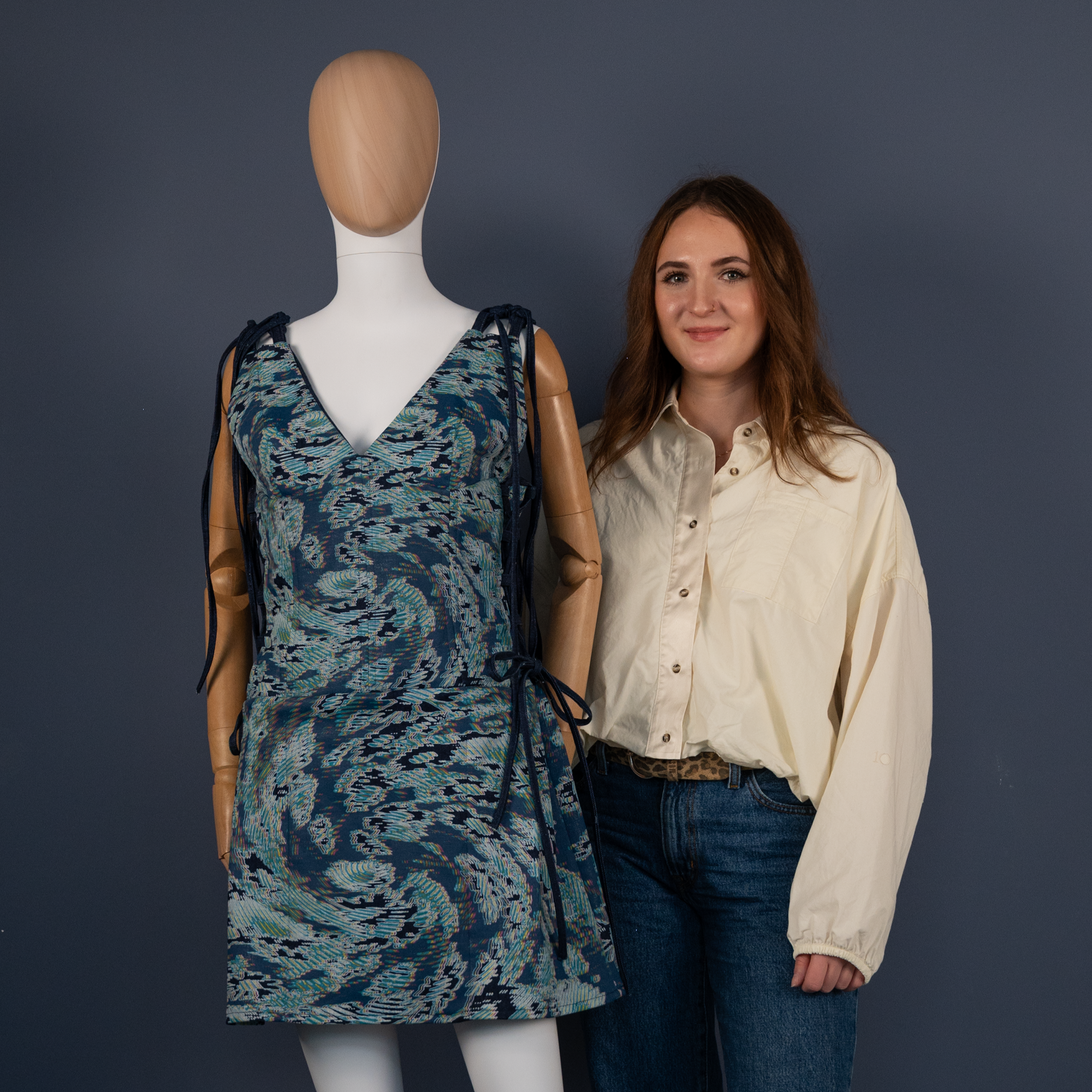
Elena Branch's unique fabrics, made to the highest environmental standards, are outstandingly original, transforming environmental issues into the coolest of design for eco-themed spaces (available for immediate purchase).
Joanne O'Rourke is expressing the value/beauty of biodiversity and nature through textile pattern (also on the market). Along with all our GREEN GRADS, she can also offer valuable insights into how to run a sustainable practice, turning considerable research, expertise, and ambitions into real-life action for an environmentally-ambitious studio.
Here’s a look at the GREEN GRADS in more detail:
Aaron Mighty
GREEN GRAD Aaron Mighty from South East London makes furniture that respects nature and its materials. Wood for each stool in his Splits and Spills collection is foraged from nearby woodland and combined with British timber offcuts. Aaron is using greenwood provided by TCV Stave Hill (The Conservation Volunteers). The timber then directly shapes designs, so each piece is different – “and has a unique character,” observes Aaron, who is “championing imperfection.” Influences on design include the structure of ships, and African artefacts. “As a Black British maker, I’ve received valuable recognition and promotion through GREEN GRADS.” Last year, Aaron completed a week-long training course in timber, woodland management and furniture-making at the Snowdon School of Furniture. Aaron has now set up his own London workshop.
Aaron Mighty, BA Product & Furniture Design, Chelsea College of Arts, UAL, 2024
Elena Branch
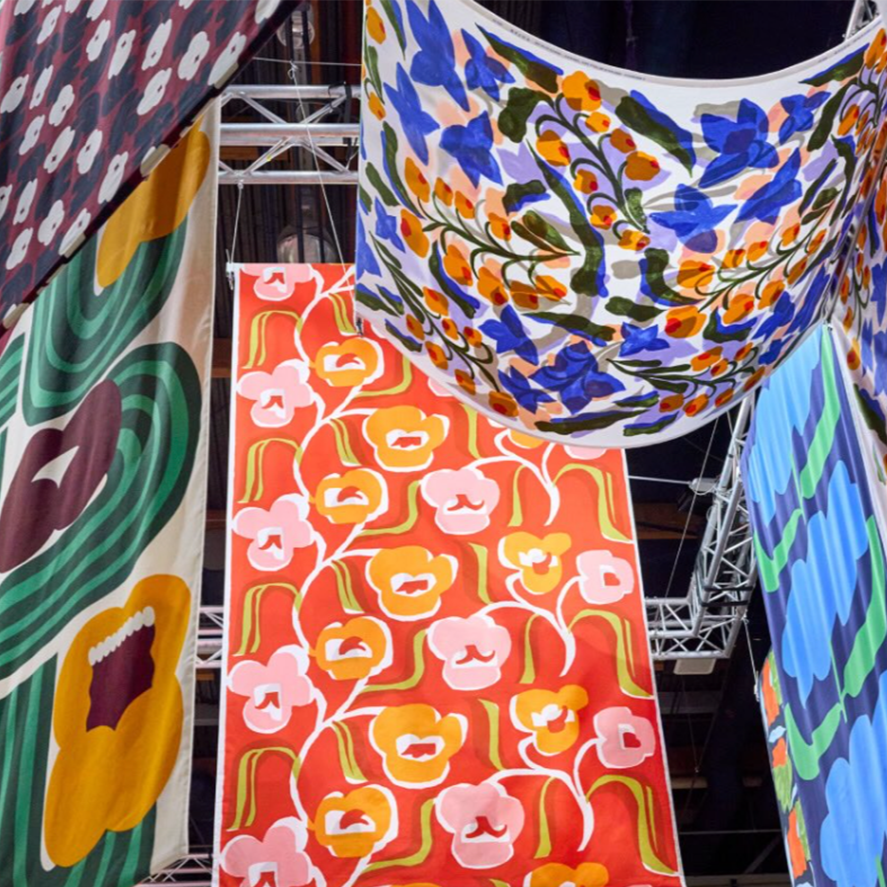
GREEN GRAD Elena Branch’s Climate Collection of printed fabrics raises awareness of the climate crisis with bold fabrics and prints, inspired by Russian Constructivism. Her strong motifs, confidently expressed in striking abstractions, speak eloquently of environmental perils: melting ice caps, plastic pollution, bleaching of coral reefs. These beautiful and often moving patterns are perfect for both commercial and domestic interiors, where they reveal a commitment to the planet in a striking and original fashion. Launching at the SDS is a new collection featuring endangered flora and fauna of Brazil. Fabrics cost £50 a metre, 140cm wide. They are heavyweight (280gsm) unbleached, organic cotton, which is OKEO-TEX 100 and GOTS certified. The pattern is digitally printed in the UK - a more sustainable way to print fabrics than traditional techniques. The fabric inks carry the OEKO-TEX Eco Passport and are ECOCERT certified. “My passion for the environment is a constantly inspires my designs – I turn factual and statistical data into fascinating and thought-provoking designs.”
Elena Branch, BA Textile Design with Business Studies, University of Brighton, 2020
Eva Xiste
GREEN GRAD Eva Xiste has invented Nover, a biomaterial made mainly from by-products: woodchips, breadcrumbs and wool from three major waste streams of carpentry, food and farming. Nover has excellent material advantages, with good strength under compression. It is biodegradable, easy to make and has no synthetic binders. It repels water and has good acoustic properties.
Possible uses include insulation and other environmentally-friendly building products, and sustainable caskets and coffins. Callen, a town with 3,000 residents in Ireland, has already demonstrated the uses of Nover in Keogh’s Model Bakery for vessels, display stands, stools and vessels.
Eva Xiste, MA Design for Industry 5.0 , Central Saint Martins, UAL, 2024
Joanne O’Rourke
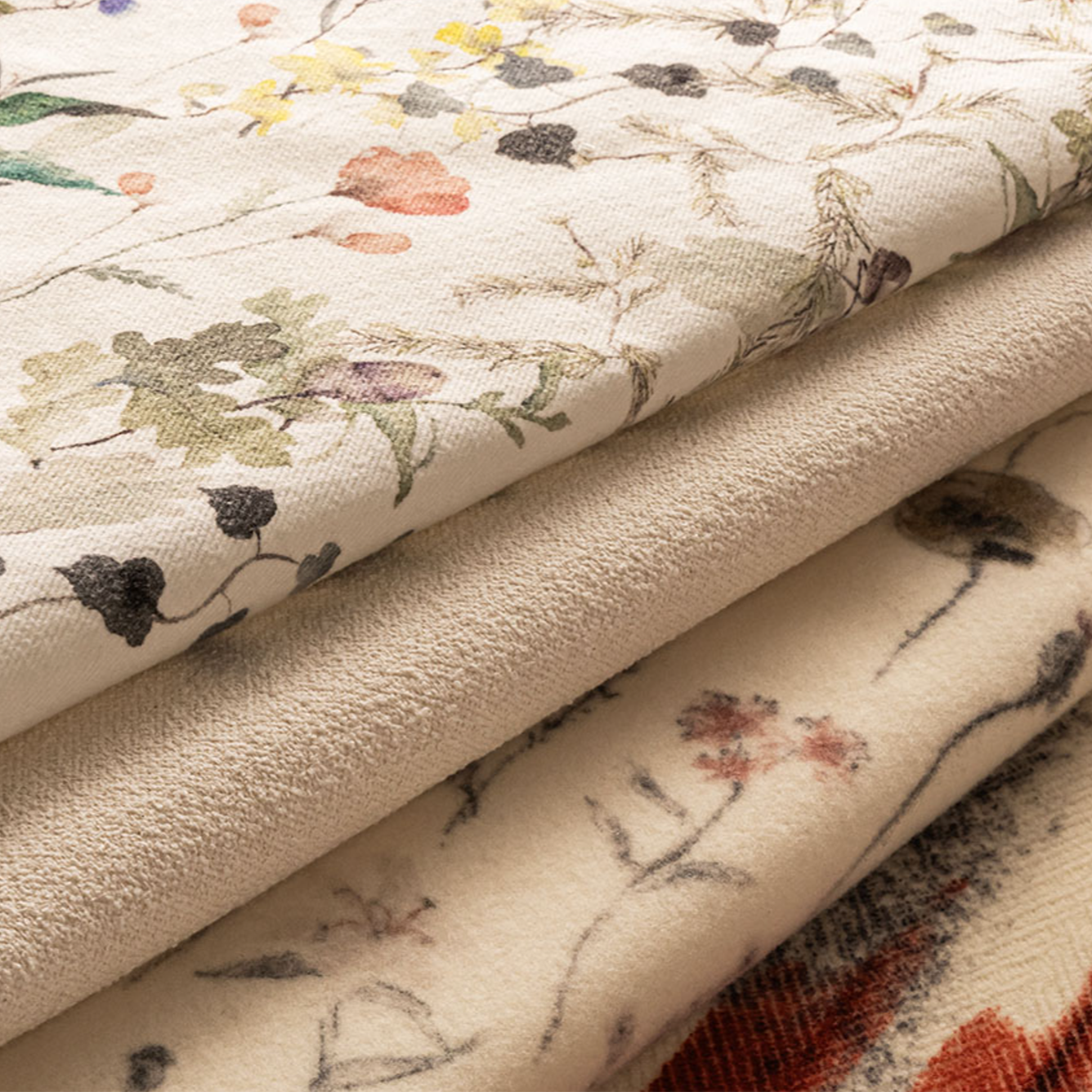
The textile practice of GREEN GRAD Joanne O’Rourke respects the environment at every turn. The abstract designs of her fabric designs are inspired by the biodiversity of meadows and marshes. Launching at SDS is a new collection printed directly from seaweed. Joanne is also researching advanced sustainable production techniques such as waterless dyeing (which eliminates water waste during the dyeing process) and pigment-based digital printing (which minimises chemical runoff while ensuring vibrant, long-lasting colour/pattern). Though not yet able personally to implement all such techniques, Joanne is advocating for their potential.
Her algae-based dyes such as spirulina and chlorella, along with traditional Japanese indigo, produce a vibrant, nature-inspired colour palette – “biodegradable alternatives to synthetic and often-toxic pigments.” Joanne is also experimenting with bioplastics made from cornstarch and agar – “these natural biodegradable materials can create both decorative and functional sustainable surfaces.”
Joanne sees research/education as a central part of her practice – investigating all aspects of sustainable textile production. She has explored the hidden contribution of microplastics and synthetic fibres to climate change. Through fibre fragmentation, microplastics enter the air, soil, and waterways, disrupting ecosystems and altering vital carbon sequestration. As an alternative, Joanne proposes regenerative crops such as hemp and flax, alongside other responsibly sourced low-impact fibres. She is also investigating innovative processes for recycled fibres.
“And of course I am promoting the circular economy, aiming to eliminate waste, circulate resources, and regenerate nature.” Thoughtful design, she believes, can address climate change and biodiversity loss. “My designs and stories are a creative vision for a more sustainable and interconnected future, leading to systemic change.”
Joanne O’Rourke, BA Textile Design, Norwich University of the Arts, 2024. @finch_marsh
Kurt Alexander
The dramatic forms and textures of GREEN GRAD Kurt’s impressive vessels intentionally evoke the surfaces and vivid colours of coral reefs before the tragic bleaching caused by climate change and warming seas – “this is to raise awareness of the issues marine life faces, and the need for reef conservations and propagation.” His work is underpinned by his own marine fish tanks and his coastal walks and diving. Ongoing, he’s committed to eco-friendly ceramic production, experimenting with wild clay from Lancashire and pit firing without a kiln. He is looking at ways of using factory waste and alternative glazes free from mined resources. And he has already has 12 years experience of commercial ceramic production bringing expertise in slip-casting, glazing and more.
Kurt Alexander, BA 3D Designer Maker, Staffordshire University, 2024.
Mathilde Wittock
Tennis is the world’s fifth most polluting sport – but GREEN GRAD Mathilde Wittock has refined its waste for SoundBounce, a sophisticated design, making use of painstakingly gathered used balls from businesses and clubs. Halved with an ingenious S-cut and coloured with dyes, these are slotted into plywood for sound-absorbing screens and furniture with an agreeably soft plush feel. “Why remove material from the earth when the planet provides free and abundant natural and man-made waste streams?” Mathilde is committed to circular design which takes into account the entire lifecycle of a product. As a bonus, Mathilde also believes in “sensory design” which engages sight, touch, hearing, and even smell to ratchet up emotional impact and social connection. Since graduation, Mathilde has worked to develop and perfect her SoundBounce range, which now comes in many colours and configurations, and is ready for commercial delivery.
Mathilde Wittock, MA Biodesign, Central Saint Martins, UAL, 2023
Scarlett Farrer
GREEN GRAD Scarlett Farrer’s Field to Fabric collection is hand-woven sustainably and ethically from hand-spun 100% natural fibres. Scarlett explains: “I’ve worked closely with local farmers, collecting their unwanted sheep fleeces and hand spinning them myself into yarn. Inspiration has come directly from the British countryside and landscapes.” Her process is completely circular so fabrics can be composted at end of life, providing nutrients for the earth. She adds: “I’ve had a passion for working with animals since I was a child. Using sheep and alpaca fleeces keeps me in touch with farming. I know exactly where my materials come from and who is making them. And I’ve changed my lifestyle to be more sustainable.” Ongoing, she is building her practice around these interests/principles, and has an ambitious five-year plan which includes cross-country trips to learn about native sheep breeds; sheering and wool handling courses; and collaborating with other emerging makers.
Scarlett Farrer, BA Textile Design with Business Studies, Specialising in Weave, University of Brighton, 2024.
Yahvi Duggal
GREEN GRAD Yahvi’s Peel Studio is a practice aspiring to zero-waste- “it’s my home and also my laboratory.” Yahvi is making bio-materials from organic waste, such as eggshells and banana skins, also adding remnants from her own textile projects. These are woven into beautiful wall-hangings. “My work shows that waste can be a valuable resource. It creates a new perspective on what we throw away.” Yahvi has formidable textile expertise acquired in her native India. For example, she has trained many Indian craft communities in the skills of natural dyeing and was on a panel as a natural dye expert at the All India Artisans and Craftworkers Association (AIACA). Her ambition is to found a crafts community in the UK for training women artisans, offering skill development, artistic collaborations and exhibition opportunities. “I care for both planet and community.”
Yahvi Duggal, MA Textiles, Royal College of Art, 2024. @yahvi98